 Multiverse Dispatch
Star Trek Limited Review: Spacecraft, Dilemmas and the Draft Archetypes
Star Trek brings Borg artifact creatures, Spacecraft and differently named lands to Limited on November 13.
Multiverse Dispatch · 3 November 2026, 20:15 · 9 min read

Star Trek’s 306-card set releases on November 13, 2026, with Limited built around Spacecraft, artifact creatures and engines that reward modal spells or differently named lands. Wizards has given the 10 colour pairs distinct plans, but several share enough material that your early picks can keep more than one route open.
Our strongest starting points are 
 artifact creatures,
 counters and
 Spacecraft. Each can turn creatures already doing useful work into a larger payoff, while flexible common removal gives you reasons to start in or without committing to a signpost.
The archetypes
Wizards built these pairs around both mechanical and creative themes, as Gavin Verhey explains in his set design article. The practical distinction is between decks that improve an ordinary creature curve and decks that need you to assemble an engine before their cards become impressive.
 uses Spacecraft and Artificers, with Constable Odo and Hemmer, Fixing What Is Broken as its signposts. Deploy creatures with enters abilities, then tap them to station ships rather than sending them into bad attacks. Common Interstellar Effigy supplies a bounce effect and another artifact creature; Guidance Failure buys time while your ships accumulate counters.
 is dilemma control, led by Seven of Nine and Lore, Positronic Provocateur. Seven of Nine costs 4 mana and draws whenever you choose modes, so the ideal sequence is to establish her before spending your remaining modal interaction. He’s Dead, Jim provides dependable common removal while you assemble that draw engine.

 is Klingon sacrifice aggro, with The Duras Sisters and L'Rell, Fierce Visionary. The latter costs 3 mana, produces a temporary hasty 2/1 each combat and supplies a sacrifice outlet. Attack first, then sacrifice a surviving token before it expires. Common Planetary Bombardment rewards the same death-heavy turns by upgrading from 2 damage to 4.
 is landfall, using Cleveland Booker, Empath and Dal R'El, Augment Orphan. Cleveland Booker, Empath makes attackers from land drops, while Dal R'El, Augment Orphan supplies temporary ramp and a late outlet for surplus lands. Common Genesis Effect fits particularly well: its land replacement produces another land entering while its 6 damage removes most creatures.
 builds counters around The Doctor, EMH and Phlox, Unorthodox Doctor. The Doctor, EMH costs 5 mana and adds counters across creatures already carrying them; Phlox, Unorthodox Doctor costs 4 and turns successful attacks by counter-bearing creatures into cards. Common Goal then converts your enlarged creatures’ power into removal. Prefer counters attached to useful bodies over spells that only distribute counters.

Phlox, Unorthodox Doctor 
Legendary Creature — Denobulan Doctor
Trample Whenever a creature you control with a counter on it deals combat damage to a player, draw a card.
 puts artifact creatures around Locutus, the One Who Speaks and Zero, Incorporeal Sensate. Locutus, the One Who Speaks is a 2-mana team pump that also has a discard-for-removal option. Common Eject the Warp Core lets a small artifact or creature trade up into a much larger threat. We favour this pair because its creatures support both pressure and efficient removal.
 rewards noncreature spells through Spock, Always Your Friend and Gray and Adira, Forever Joined. The latter costs 4 mana and creates a temporary creature copy at combat if you have cast a noncreature spell that turn. Cast common Plasma Cascade before combat to clear a blocker and enable the copy, rather than automatically saving it for the opponent’s turn.
 wants cards to leave its graveyard, with Vash, Freelance Archaeologist and Daniels, Temporal Agent. Vash, Freelance Archaeologist stocks the graveyard and rewards cards leaving it; Daniels, Temporal Agent supplies both recursion and a later graveyard exit. He’s Dead, Jim contributes removal and surveil. This pair needs actual ways to move cards out, not merely a large graveyard.
 attacks while its creatures have at least 8 total power, using Kirk, Commanding Officer and Worf, Honor-Bound Warrior. Build a board before trading creatures casually: Kirk, Commanding Officer turns the threshold into access to another card. Plasma Cascade helps preserve your attackers by removing a blocker before combat.
 counts differently named lands, with D'Vana Tendi, Optimistic Ensign and The Traveler. Common named lands such as Earth, Sector 001 matter beyond their mana production. Wizards’ Prerelease guidance explicitly recommends considering off-colour lands for this strategy. A new land name is a payoff resource, but it must not stop you casting your spells.
The mechanics
Beam me up appears on 10 cards and works like graveyard spell reuse with a creature-return cost. Wizards’ mechanics explanation confirms that returning the creature is part of casting, so opponents cannot remove it in response to prevent that payment. Reusing an enters ability is the reward, but replaying the creature costs mana and temporarily shrinks your board.
 Face a dilemma means choosing modes, not resolving the spell. Choosing several modes on one spell still counts as 1 dilemma, and a counterspell does not undo the choice. That makes modal creatures particularly useful: they can supply a body for station while also triggering Seven of Nine or growing Jett Reno, Problem Solver.
Station appears on 17 cards. You tap another creature at sorcery speed to add charge counters equal to its power, so a creature can help launch a ship instead of attacking. Counters remain available for the card’s later thresholds; do not evaluate every Spacecraft as though it must become a creature immediately.
Federation counts creature types among non-Borg creatures, while Strange new worlds counts land names once each. Their deck-building incentives differ: Federation wants varied personnel, and Strange new worlds wants varied lands. Assimilate, found on 2 cards, turns its subject into a Borg artifact creature with a +1/+1 counter, making it useful to the artifact plan while removing its contribution to Federation.
White and Blue
Malfunctioning Holodeck is our first common pick. For 3 mana it temporarily exiles any opposing nonland permanent, with ward making the answer harder to remove. Crucially, it answers a Spacecraft before station turns it into a creature. Its artifact status is useful, but it is not an artifact creature for Locutus, the One Who Speaks.
 White Auracite is a close past card with a 59.6% 17Lands games-in-hand win rate across 76,890 games in its own format. That history backs taking this kind of broad answer early; the percentage belongs to White Auracite, not Malfunctioning Holodeck.
Malfunctioning Holodeck · its closest past cards, and how they did in Limited

New · common
59.6% GIH WR
FIN · 76,890 games · 88% similar
Games-in-hand win rate of each past card on 17Lands; similarity from tags, rules text and body (ManaRadar).
Command Decision is another early pick: 2 mana buys a large-creature answer or a replacement card. Its removal mode reaches only 22.3% of the set’s creatures by printed power, so the draw mode carries real weight. Close past card Surgical Precision recorded 58.0% games-in-hand over 30,761 games on 17Lands.
Command Decision · its closest past cards, and how they did in Limited

New · common

58.0% GIH WR
FRA · 30,761 games · 82% similar
Games-in-hand win rate of each past card on 17Lands; similarity from tags, rules text and body (ManaRadar).
 At uncommon, U.S.S. Excelsior, Cutting Edge is premium. Its 4-mana entry destroys a tapped opposing creature before you invest anything in station. Set Phasers to . . . is a solid cheap common, though its damage mode requires an attacker; it cannot clear a blocker before your own combat.
 For , Guidance Failure is dependable common interaction that can tuck a creature or Spacecraft, costing 3 mana against an attacker. Interstellar Effigy is a solid 5-mana common because bouncing a creature also leaves an artifact body. At uncommon, 2-mana Jett Reno, Problem Solver links dilemmas to station: choosing modes grows her, and tapping her surveils or eventually draws.
Black
 He’s Dead, Jim is the safest early common in : 4 mana removes a creature without a size restriction and adds surveil. Eject the Warp Core is cheaper at 2 mana, but its base -2/-2 reaches only 45.8% of the set’s creatures. Draft sacrifice material alongside Eject the Warp Core, rather than treating -6/-6 as free.
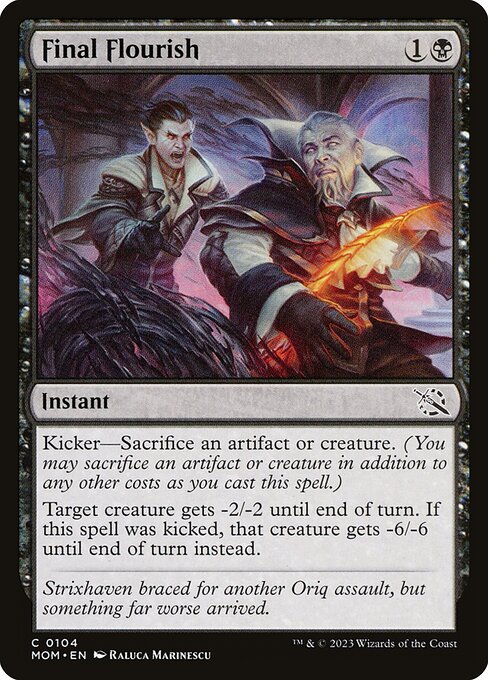 Final Flourish, a close past card, posted a 57.4% 17Lands games-in-hand win rate across 140,446 games. That is useful precedent for the sacrifice upgrade, particularly in a set where artifact creatures and temporary Klingon tokens provide expendable material.
Eject the Warp Core · its closest past cards, and how they did in Limited

New · common
57.4% GIH WR
MOM · 140,446 games · 99% similar
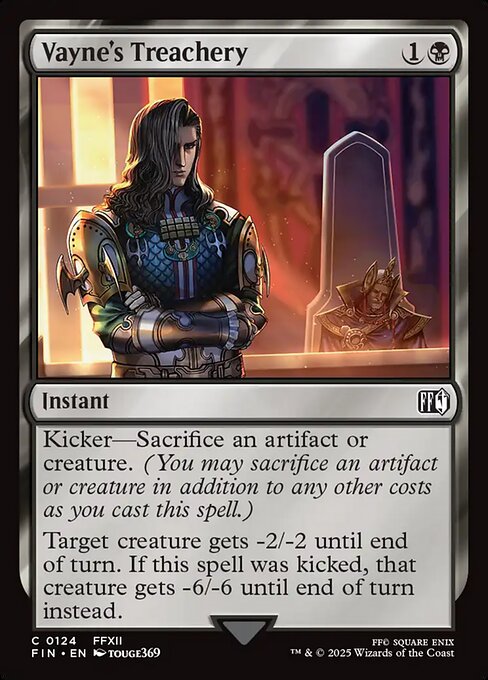
57.9% GIH WR
FIN · 91,757 games · 99% similar

57.8% GIH WR
TMT · 25,449 games · 93% similar
Games-in-hand win rate of each past card on 17Lands; similarity from tags, rules text and body (ManaRadar).
 Impossible Choice is a strong 3-mana uncommon, but destroying a creature gives its controller 2 Officer tokens. Use it against a threat whose text matters more than its body, or choose the draw mode. De-evolve is solid 2-mana interaction against attackers, though reducing power and preventing blocks does not switch off a creature’s other abilities.
Red and Green
 Plasma Cascade is an early common pick for : 3 mana deals 3 damage to any target and offers a rummage. The removal analysis puts that damage at 74.7% of the set’s creatures, compared with 98.2% for 5-mana Genesis Effect’s 6 damage. The latter is solid top-end interaction, with landfall and land-name applications compensating for its cost.
Removal in Star Trek · 43 spells for 166 creatures
| 7 | Malfunctioning Holodeck exile · 70,000 Light-Years from Home exile |
| 5 | Guidance Failure tuck · Interstellar Effigy bounce |
| 10 | He's Dead, Jim destroy · Impossible Choice destroy |
| 11 | Khaaaaaaaaaaaannn! x damage · Genesis Effect 6 damage |
| 3 | Test of Courage destroy · mv ≤ 3 · artifact · Common Goal fight |
| Multi | 4 | Borg Cube exile · Locutus, the One Who Speaks 2 damage |
 | 3 | Crystalline Entity sweeper · destroy · nonartifact · Spatial Anomaly 2 damage |
 Planetary Bombardment is a good aggressive role-player, especially when a disposable attacker can die first. Perils of the Past deserves main-deck consideration because its artifact-destruction mode covers Borg creatures and unstationed ships. At uncommon, Transporter Malfunction is premium 2-mana damage, although its 6-mana Beam me up cost makes the second casting a late-game play.
 Common Goal is the common to prioritise. For 2 mana, up to 2 of your creatures deal their power to one opposing creature without taking return damage. It is better than an ordinary fight spell when your board is small but wide. Amok Time is a solid uncommon for creatures that can win a fight; Test of Courage is narrower filler because its permanent-removal mode stops at mana value 3.
The bombs and traps
 Borg Cube costs 7 mana before affinity for artifact creatures and immediately threatens to exile a creature. MTG Arena Zone’s review gives it 4.0/5, stressing that it pays you back even without reaching station 12. We agree: draft it as discounted removal with an eventual assimilation engine, not as a ship that must attack to justify its slot.
 Captain Jean-Luc Picard is a bomb at 3 mana because the team bonus and Officer production work without the Spacecraft-search ability. Mr. Spock, Science Officer costs 4 and doubles your draws, making even the next draw step a substantial return. Both demand a prompt answer rather than a specialised supporting deck.
 The City on the Edge of Forever is the trap. MTG Arena Zone rates the 5-mana Saga 2.0/5 because its sweeper sequence needs another token and a fragile 0/1 to survive. We would take reliable removal over a plan that gives the opponent that much opportunity to interrupt it.
 The Destruction of Praxis is more dependable, but its 5-mana sweeper scales with different land names rather than lands in total. Check that number before casting it. Kobayashi Maru Scenario offers a strong 3-mana value engine, though its bounce, cards and tokens arrive through successive upkeeps rather than immediately.
What the creators say
NicolaiBolas’s draft guide puts Malfunctioning Holodeck first among the commons, while Jim Davis’s evaluation calls it a common bomb. We take it over the narrower common answers because it covers both creature engines and ships still waiting for counters.
 Lore, Positronic Provocateur divides reviewers. Draftsim’s archetype guide calls it an efficient dilemma enabler, while Limited Level-Ups gives the 3-mana 2/3 a D+. Limited Level-Ups also warns that dilemma payoffs are not especially numerous. Our verdict is to secure the payoff before raising the value of an otherwise modest enabler.
Zero, Incorporeal Sensate drew the most attention in the creator tally, appearing in 15 videos or episodes. The 3-mana lifelinker looks at the opponent’s hand and taxes an exiled nonland card by ; the opponent can still play that card. We value the information and delay in an artifact-creature deck, but it is not permanent hand removal.

Zero, Incorporeal Sensate 

Legendary Artifact Creature — Medusan Scientist
Lifelink
When Zero enters, look at target opponent's hand. You may exile a nonland card from it. For as long as that card remains exiled, its owner may play it. A spell cast this way costs more to cast.
$1.94 · €0.23
How to draft the first week
We expect a midrange starting point: station asks creatures to spend turns tapping rather than attacking, and several engines reward repeated setup. Monocolour average mana values range from 2.91 in to 3.42 in , but actual game length remains unknown. Keep useful 2-drops ahead of extra expensive payoffs when the picks are close.
Start with broad removal, then count the resources your signpost actually needs. For , count artifact creatures rather than artifacts; for , count ways to put counters on creatures while developing your board. For , count different land names without pretending every off-colour land is painless.
 Wizards’ play schedule runs Prerelease from November 6 to November 12, 2026. In those first pools, give Perils of the Past more respect than a normal artifact answer: it can remove a Borg creature or a Spacecraft, and its pump mode keeps it useful when neither target appears.
Sources
- Wizards of the Coast — magic.wizards.com/news — Where to Play Magic: The Gathering® | Star Trek™, 28 October 2026
- Limited Level-Ups on Seven of Nine — Star Trek Limited Set Review! | Multicolor + Colorless | 1/6
- Nizzahon Magic on Lore, Positronic Provocateur — Magic: the Gathering | Star Trek Set Review - Multicolored & Colorless
- Wizards of the Coast — Magic: The Gathering | Star Trek Prerelease Guide, 30 October 2026
- Page: Star Trek (TRK) Limited Set Review: Multicolor • MTG Arena Zone
- Page: Trekking Through Design
- Jim Davis on Malfunctioning Holodeck — ⚪ Complete Set Review! ⚪ - 🚀 Star Trek 🚀 - White Cards - Constructed And Limited
- NicolaiBolas on Malfunctioning Holodeck — STAR TREK DRAFT GUIDE!!! Top Commons, Archetype Overviews, and MORE!!!
- Limited Level-Ups on Pure Energy — Star Trek Limited Set Review! | White | 6/6
- Page: Magic: The Gathering® | Star Trek™ Mechanics
- Page: Exploring All Ten Star Trek Limited Archetypes - Draftsim
- Card: The Doctor, EMH
- Card: Phlox, Unorthodox Doctor
- Card: L'Rell, Fierce Visionary
- Card: Seven of Nine
- Card: Gray and Adira, Forever Joined
- Card: Zero, Incorporeal Sensate